


Activities let you teach your AI agent to recognize specific lead behaviors on your website and adjust its outreach accordingly. You define criteria, like "the visitor asked about pricing" or "the visitor browsed the integrations page for more than 30 seconds" - and the AI will automatically detect when those criteria are met during a lead's session.
Once detected, activities can trigger AI email campaigns and shape how your agent crafts follow-up emails. This makes outreach more relevant to what the lead actually did or said.
Configuring activities
To configure custom activities, follow these steps:
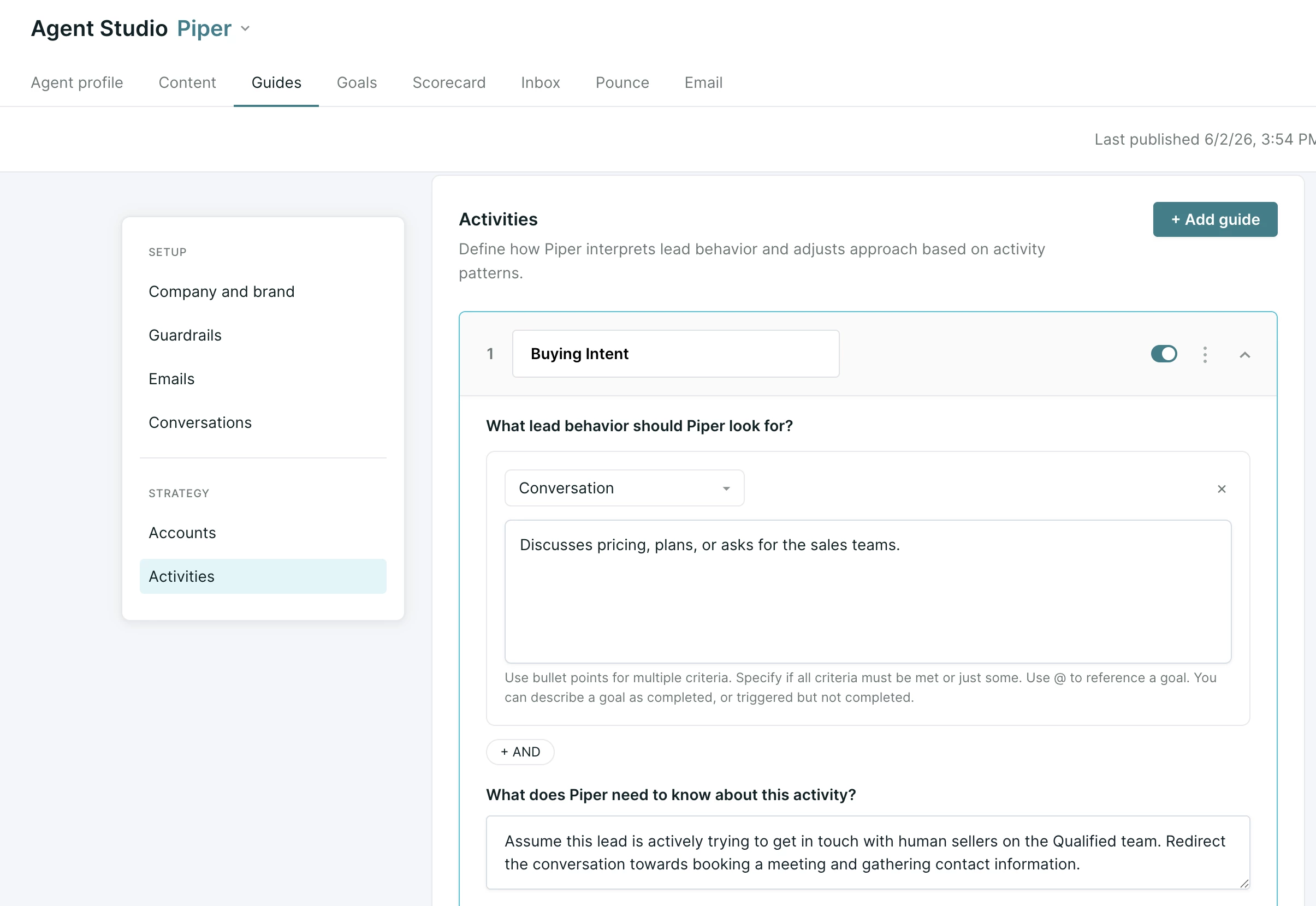
- Navigate to Settings > Agent Studio > Guides > Activities
- Click + Add guide. You will configure the following sections:
- Activity name: Give your activity a clear, descriptive name. You’ll use this name to select the activity in campaign triggers, and for your own reference.
- Criteria: Configure one or more lead behaviors that the lead may take which should trigger this guidance. More detail is provided on these criteria below.
- Messaging guidance: Tell your agent how to adjust its messaging when the criteria in #2 is met. For example, “Emphasize ROI and offer a call with a solutions engineer” or “Acknowledge their interest in the Enterprise plan and highlight key differentiators”
- When your custom activity is complete, click Save.
- Optionally, use the Toggle to control whether the custom activity is enabled or disabled.
Pro tip: Disabled activities won’t be evaluated. Use this feature to “pause” listening for an activity without deleting it!
Activity criteria
Each activity has one or more criteria blocks. For each criterion, you choose a lead activity type and provide instructions.
Lead behavior
When defining the lead behavior to watch for, activities are broken into two types - conversations and browsing behavior.
-
Conversation: Evaluates chat transcripts between the visitor and the AI assistant. Use this when the behavior you care about is something the visitor said or asked about.
-
Browsing behavior: Evaluates pages visited and time spent on pages. Use this when the behavior is about where the visitor went on your site.
An activity can include multiple behavior criteria, and those criteria can mix or match among the behavior types. For example, if a visitor has browsed the pricing page and asked about the difference between pricing plans, you can provide guidance to your agent on how to describe the value added in higher-tier plans.
Instructions
Regardless of the activity type, use the text box that appears to describe in natural language what your AI agent should look for. For example:
-
"The visitor asked about pricing or requested a demo."
-
"The visitor spent more than 60 seconds on the pricing page."
-
"The visitor submitted a contact form."
Use bullet points if you have multiple criteria and specify whether all conditions must be met or any one of them. Be specific - reference page URLs, topics, or keywords you care about.
Behavior scope
Activities don't just look at what happened in a lead's most recent session. Your agent can also evaluate up to 90 days of past session history. This means your instructions can reference patterns and behaviors that span multiple visits, such as:
-
Frequency or counts: e.g., "Visited the pricing page in at least 3 different sessions."
-
Cross-session patterns: e.g., "Returned to the product page across multiple visits."
-
Recency conditions: e.g., "Asked about pricing within the last week."
If your criteria only concern the current session, the AI will focus on that session alone. When your instructions involve counts or patterns, your AI agent will automatically consider the full history available.
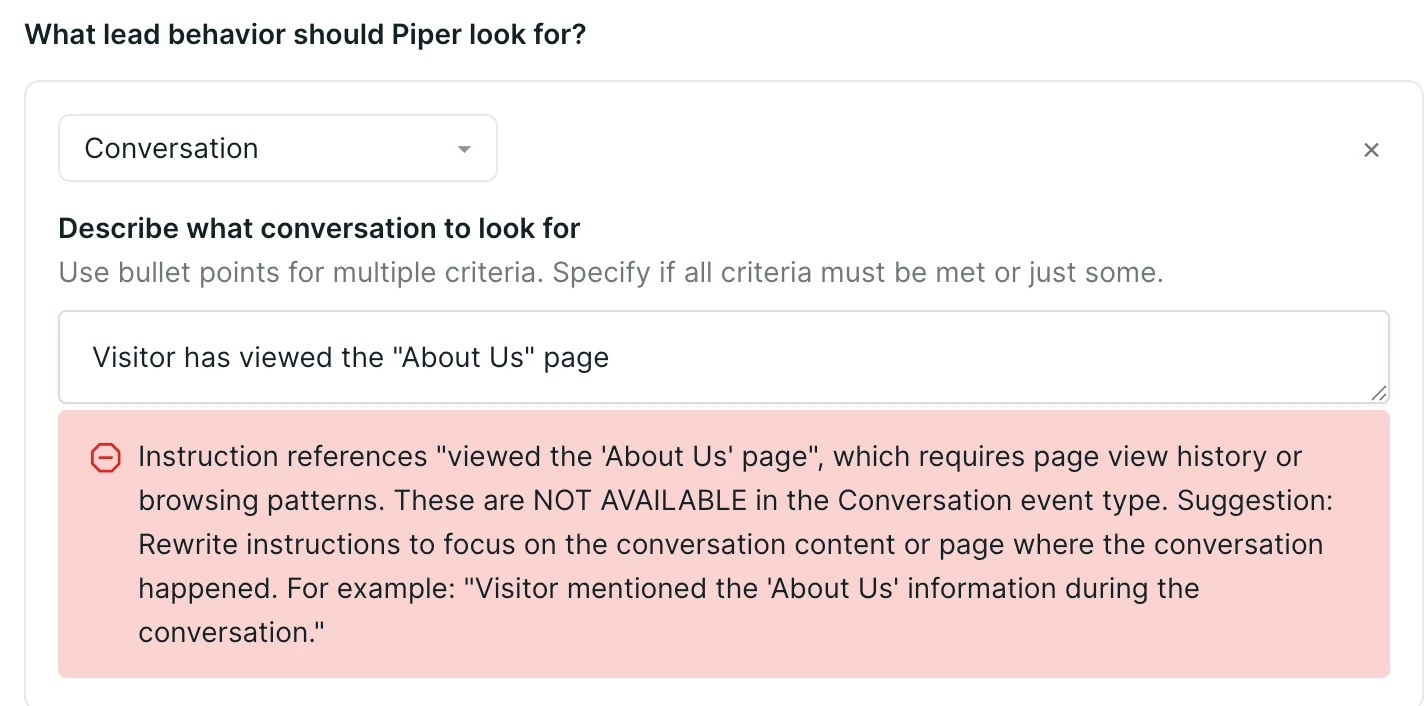
Instruction validation
When you write criteria instructions, the system automatically validates them to ensure they are feasible based on the selected activity type. For example, a Conversation activity has access to chat transcripts but not page view history. If your instructions reference data that isn't available, you will see a warning with a suggested revision.
Using activities in campaigns
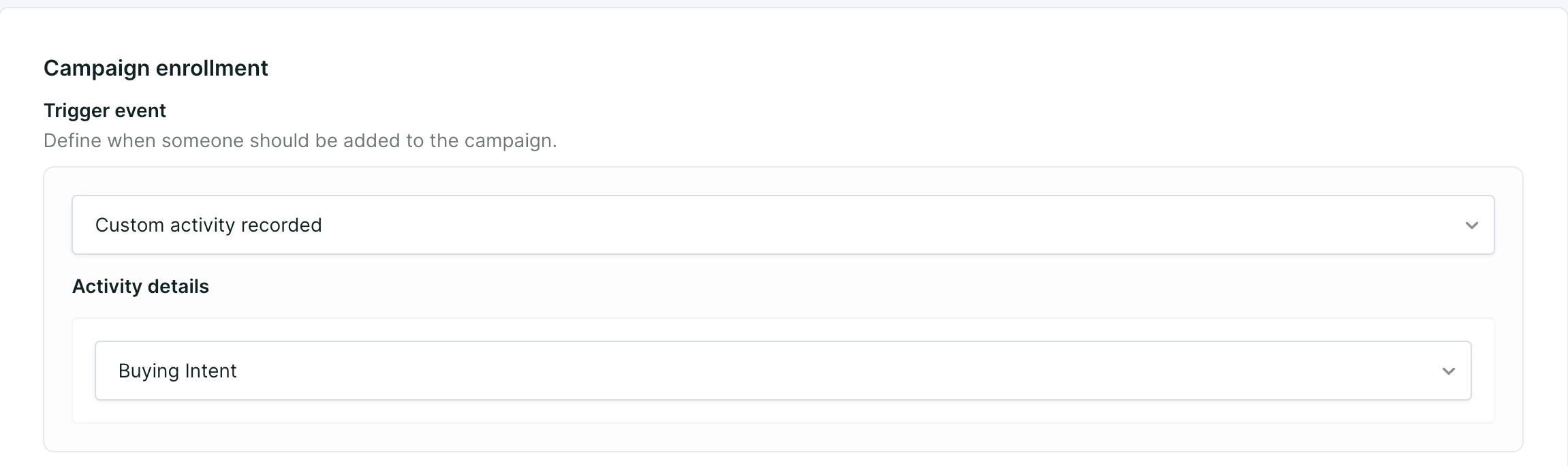
Once you have created and enabled a custom activity, you can use it as a campaign trigger:
-
Go to your Campaign Settings and set up a new campaign (or edit an existing one).
-
Choose Custom activity recorded as the trigger type.
-
Select the specific custom activity from the dropdown.
When the selected activity fires for a lead, that lead will be enrolled in the campaign automatically.
Best practices
-
Start simple: Begin with one or two high-value activities, such as pricing inquiries or demo requests.
-
Be specific: The more precise your criteria, the more accurate the detection.
-
Use messaging guidance thoughtfully: Describe the tone and focus you want rather than telling the AI exactly what to say.



.svg)


